Department of Psychological & Brain Sciences
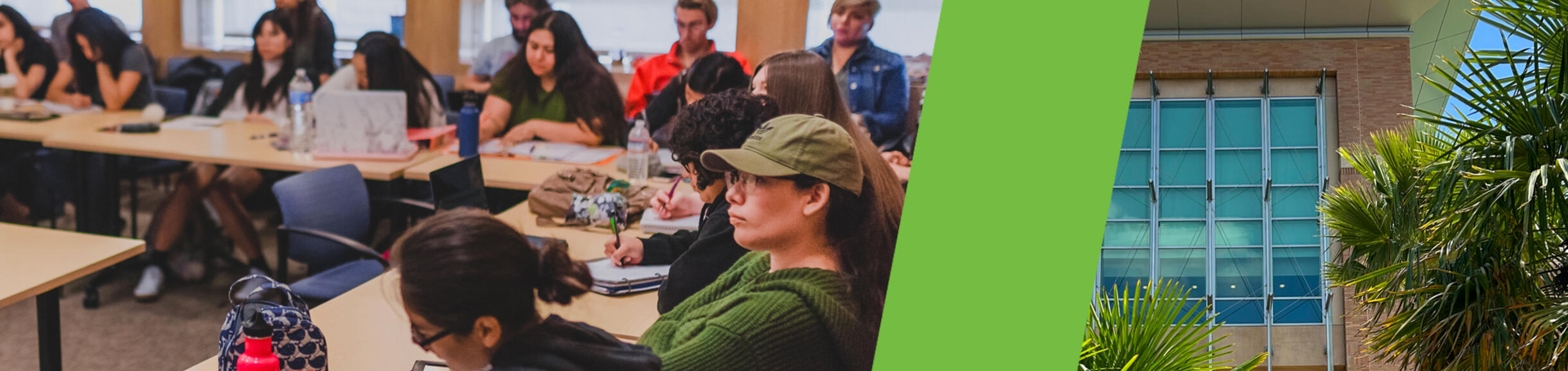
For undergraduate instruction, UCR Psychology provides students with a broad range of opportunities in coursework, research experience, and applied internships. Scientific research is a significant focus in the department where most classes emphasize theoretical approaches and also the methods of scientific investigation of critical psychological questions. There are many undergraduate research opportunities in the wide variety of laboratories in the department. General areas of study include thinking and perception, brain and behavior, development and aging, personality and motivation, language and communication, groups and identities, and health and well-being.
Undergraduate students can pursue a Bachelor of Arts (B.A.) or Bachelor of Science (B.S.) degree in psychology. In addition, we offer interdisciplinary degrees in Law & Society and Neuroscience.
Bachelor of Arts
The B.A. degree in psychology is designed to provide broad exposure to fundamental knowledge in psychology and to methods psychologists use to conduct research.
Bachelor of Science
The B.S. degree in psychology has a similar focus to our B.A. degree. However, there is a greater focus placed on research methodology, theory, and training within the many research labs in our
department.
Potential careers: Both the B.A. and B.S. degrees prepare students for graduate studies in psychology. Graduates also go on to careers in personnel work, government services, business administration, probation and parole, mental health work, or positions as trainees in a variety of programs and professions. Others continue to law school, medical school, or social work.
What is the Bachelor of Science degree track?
The Psychology faculty has designed the Bachelor of Science track to help our majors succeed in applying to top, research-focused graduate psychology programs. Students in the Bachelor of Science track get a research-intensive curriculum, with a particular focus on laboratory courses in psychological research and hands-on research experience.
Which students is the Bachelor of Science degree designed to serve?
The Bachelor of Science track is particularly tailored for students who aim to pursue a research career or graduate education in Psychology that involves a research component (e.g., Ph.D., Masters of Psychological Science). Please note, if you are a Psychology, Law & Society major, unfortunately, there is no option to change your major to a Bachelor of Science in Psychology, Law & Society.
Major Change Criteria:
- Good Academic Standing
- Ability to complete the degree within 216 units
- If upper-division courses have been taken, a minimum upper-division GPA of 2.0
- Completion of PSYC 1, PSYC 2, PSYC 11* and, PSYC 12* with grades of C- or better
- Completion one course in calculus: MATH005B, MATH 005C, MATH 009A, MATH 009B, MATH 009C, MATH 007A, MATH 007B, or MATH 22) with a grade of C- or better
- Completion of one additional Formal Skills course (a course in Computer Science, Statistics, Data Science, or Mathematics) with a grade of C- or better
*Please note: PSYC 011 and PSYC 012 have a prerequisite of MATH 4 or higher
Neuroscience
The Neuroscience degree is offered as both a B.A. and B.S. It’s an inter-college major that emphasizes the functioning of the nervous system at the molecular, cellular, system, behavioral and cognitive levels. Some of the topics covered include neuroanatomy, neurophysiology, and neurochemistry in humans and other animals.
Potential careers: A bachelor's degree in neuroscience, particularly a B.S. degree, prepares students for graduate studies in Neuroscience, while others continue onto applied fields of study (e.g., audiology, speech-language pathology), or medical school. Graduates also go on to careers in the health industry.
- BA or BS in Neuroscience Major
- 4-year Sample Plan for BA in Neuroscience
- 4-year Sample Plan for BS in Neuroscience
- 2-year Sample Plan for BA or BS in Neuroscience
Psychology – Law & Society
The Psychology – Law & Society interdisciplinary B.A. degree couples the study of psychology with an interdisciplinary liberal arts approach to the study of legal and law-like relationships and institutions. It provides students with a coherent and rigorous program around the theme of law through the lens of psychology.
Potential careers: Similar to those of traditional Psychology majors. Many psychology-law & society majors go on to graduate school in public policy or law school.
- BA in Psychology, Law & Society Major
- 4-year Sample Plan for BA in Psychology, Law & Society
- 2-year Sample Plan for BA in Psychology, Law & Society